
Mobile AI systems can be trained, tested, and evaluated across different execution environments.
Synthetic data, emulators, and real devices can all contribute useful interaction evidence, but they expose different parts of the problem.
The important question is not which environment is universally preferred.
It is which environment provides the evidence required for the task being studied.
Different Sources Provide Different Evidence
A data source is also an observation boundary.
It determines which states, behaviors, and environmental conditions can be represented in an interaction record.
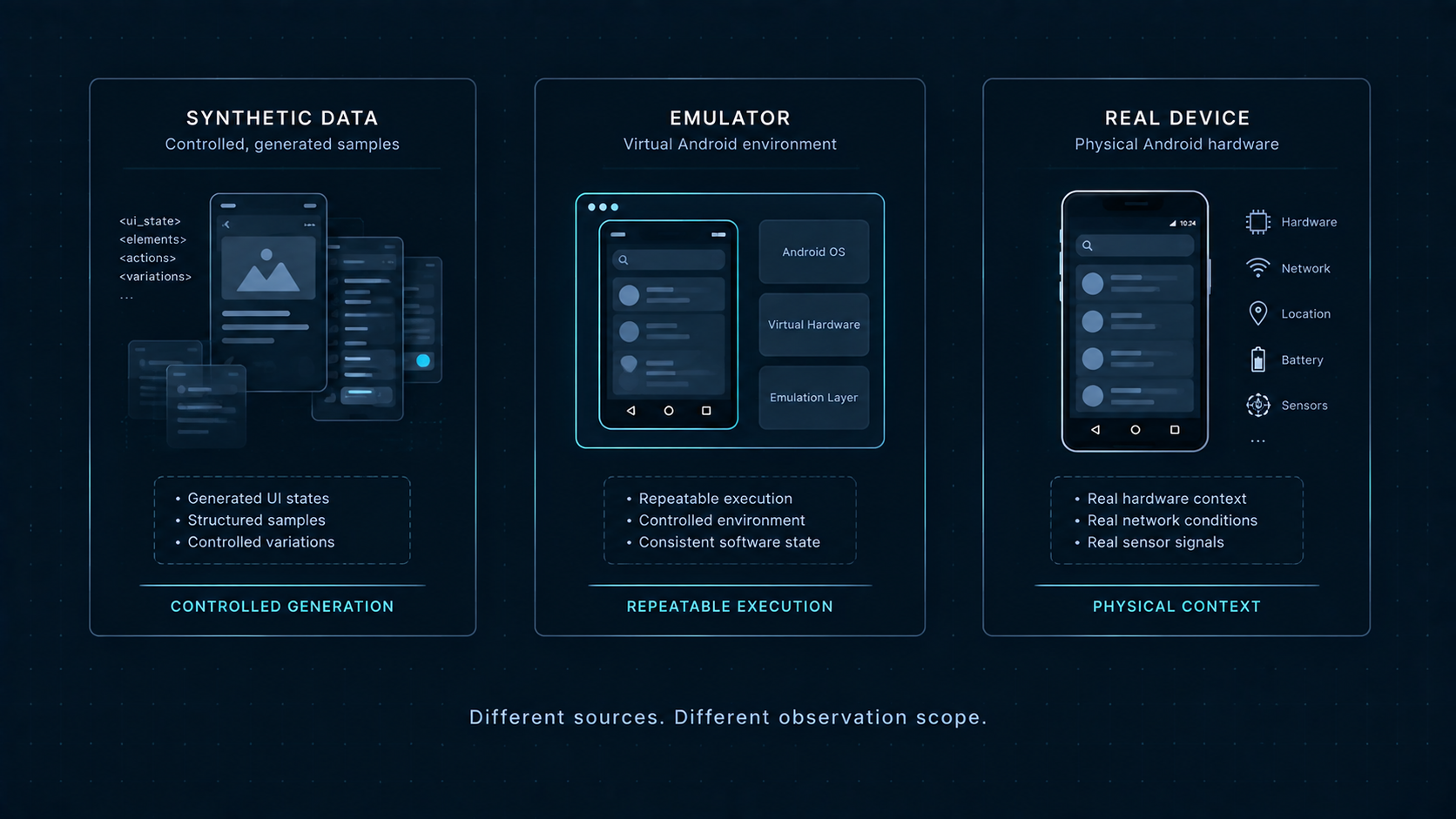
Synthetic data can generate controlled possibilities. Emulators can execute Android software inside a repeatable virtual environment. Real devices can expose interactions to physical hardware and real execution conditions.
These are different observation scopes rather than stages in a fixed hierarchy.
Synthetic Data: Controlled Possibilities
Synthetic data is useful when the objective is to generate controlled examples of states, layouts, actions, or variations.
Because the data is generated rather than captured from a running physical environment, its structure can be defined explicitly. This makes it useful for exploring combinations that may be expensive or slow to collect through execution alone.
A synthetic workflow may generate UI states, structured samples, task variants, or controlled edge cases.
Its evidence is strongest when the question concerns possible states, controlled variation, or coverage of a defined space.
What it does not automatically provide is evidence that those states occurred under a particular Android runtime, hardware configuration, network condition, or physical device state.
Emulators: Repeatable Software Execution
An emulator introduces execution while keeping much of the environment controlled.
Applications can run inside a virtual Android environment, actions can be repeated, and software state can be reproduced with relatively predictable conditions.
This is useful when the question depends on application behavior, Android software behavior, or repeatable execution rather than physical hardware context.
Emulators can therefore provide evidence about how an interaction unfolds inside a defined virtual environment.
The boundary is equally important: virtualized hardware and controlled system conditions do not represent every signal that may appear during physical execution.
Real Devices: Physical Execution Context
Real devices place the interaction inside physical Android hardware.
The execution can include device-specific behavior, real network conditions, location-related state, battery behavior, sensors, and other properties that exist outside a purely virtual environment.
This matters when those properties are part of the question being asked.
A real device does not make an interaction record useful by itself. Observations, actions, state changes, and outcomes still need to be captured and related in a usable structure.
What the physical device contributes is an execution context from which additional evidence can be observed.
Different Questions Require Different Environments
The environment should follow the observation requirement.
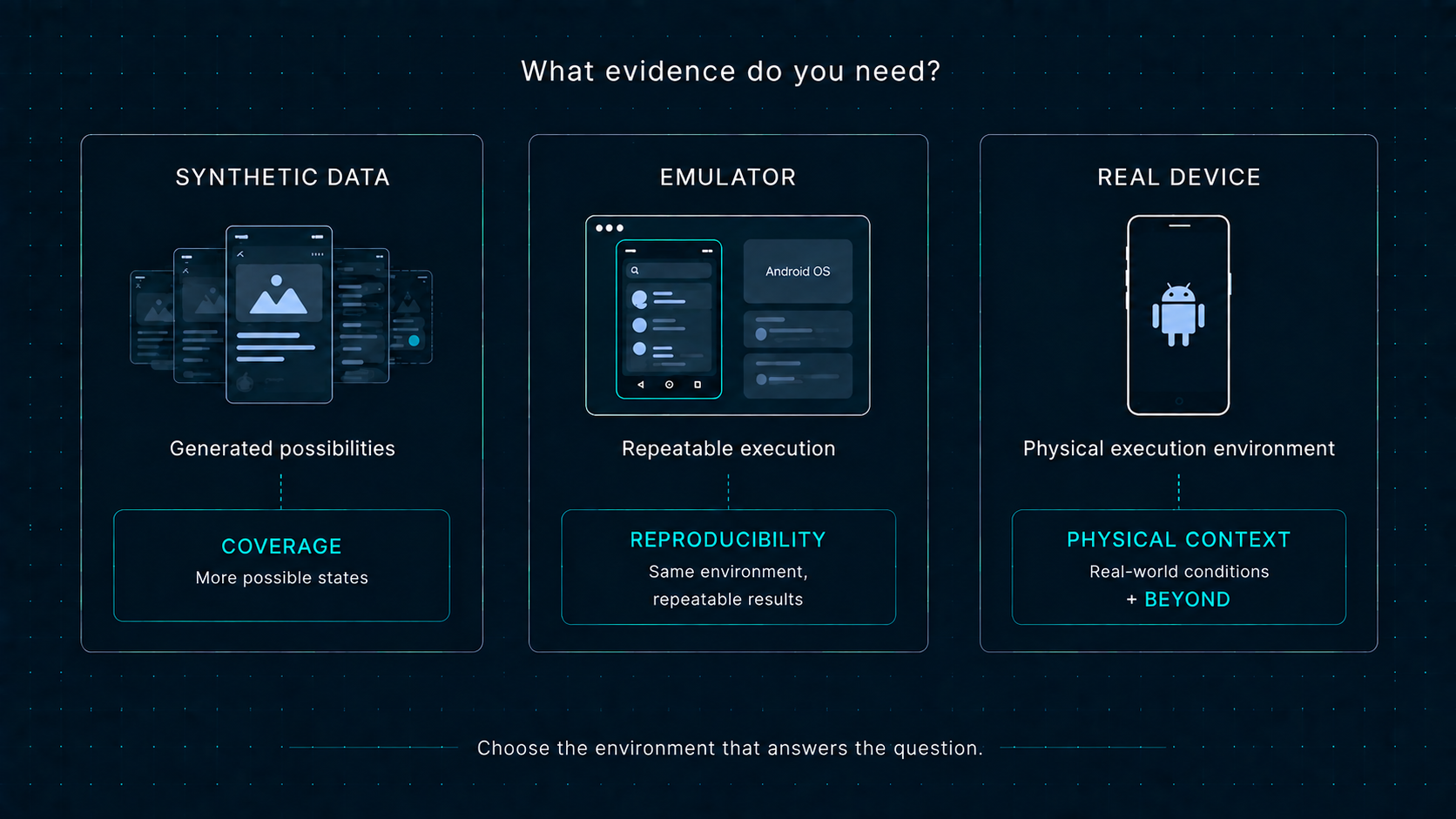
If the question is about generating many controlled UI possibilities, synthetic data may provide the required evidence.
If the question is about repeatable application behavior inside Android, an emulator may provide the required execution context.
If the question depends on physical hardware, real networks, sensors, device state, or other real-world conditions, a physical device may be necessary to observe those properties.
The distinction is not about assigning a universal quality level to each environment.
It is about matching the evidence source to the question.
A Practical Mobile AI Data Pipeline
In practice, a Mobile AI data pipeline can use more than one environment.
Synthetic generation can expand controlled possibilities. Emulator execution can provide repeatable software runs. Physical devices can add evidence from real Android execution contexts.
These sources can feed the same broader interaction model when the records preserve compatible structure and relationships.
This sequence should not be read as a required progression.
A workflow may use one source, several sources in parallel, or different sources at different points depending on what must be observed.
The Smallest Environment That Answers the Question
A useful selection rule is to choose the smallest environment that can provide the evidence the task requires.
This keeps the execution model aligned with the research or evaluation question instead of adding environmental complexity without a corresponding observation need.
The question can be framed simply:
What evidence do you need?
Then choose the environment capable of producing that evidence in a form that can be preserved, compared, and interpreted.
Real Android Infrastructure for Mobile AI
For workflows that require physical execution context, real Android infrastructure provides the environment in which those interactions can occur.
Its role is not to replace synthetic generation or emulator-based execution.
It provides a physical execution layer for questions that depend on evidence from real Android devices, real networks, device state, or other hardware-linked conditions.
Across all three environments, the same data principle remains: useful Mobile AI data depends not only on where an interaction runs, but also on how its observations, actions, state changes, and outcomes are preserved.